
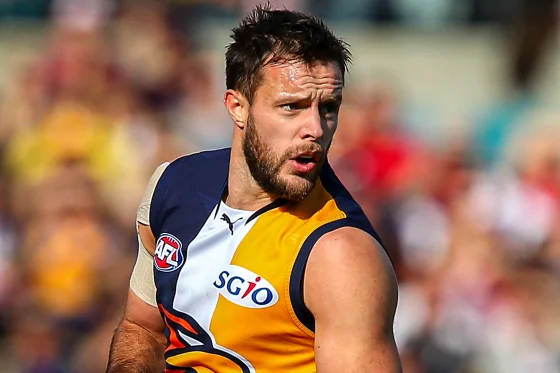
Mitchell Brown in Perth, Australia, in 2013.
Melbourne, Australia — Former West Coast Eagles defender Mitch Brown publicly announced that he is bisexual on Wednesday, becoming the first male player (current or retired) in the history of the Australian Football League (AFL) to openly disclose his LGBTQ+ identity. The player, who spent a decade with the West Coast Eagles before 2016 and played 94 matches, stated that he hoped his action would encourage more footballers to bravely be open about themselves.
In the over 100-year history of the AFL's top-tier competitions, no male player had publicly acknowledged being gay or bisexual prior to Mitch Brown. In an interview with The Daily Aus website, Brown revealed that he had kept his sexual orientation a secret during his professional career, partly due to the "hyper-masculine" culture present in the AFL environment.
"I remember once hearing two people talk about how they would feel showering with a gay man, and one of the players said, 'I'd rather be in a cage full of lions than shower with a gay man,'" Brown recalled. He also mentioned that in his life, there were countless times when he chose to remain silent upon seeing or hearing similar inappropriate remarks, simply because he feared others would suspect he was gay or bisexual.
By choosing to come out about his sexual orientation now, Brown hoped to provide more people with "safety, comfort, and space" to have the courage to step forward and be open about themselves. "The reactions I hope for are perhaps the ones I won't hear," he added. "I hope young men across Australia will think, 'I feel seen, I feel safer, and now I have a role model — even if it's just ordinary old Mitch — someone I can look up to at last.'"
Notably, less than a week before the 36-year-old player came out, Izak Rankine, a forward for the Adelaide Crows, became the sixth AFL-listed player to be suspended in two seasons for using a homophobic slur during a match.
For a long time, the AFL has positioned itself as a leader in promoting inclusion and diversity in the sports industry, and has also collaborated with LGBT organizations to launch campaigns advocating for equality. However, the fact that there have never been male players in the league who openly identify as gay has raised questions from the outside world: whether the sports league has taken sufficient measures to create a safe environment for LGBTQ+ individuals in clubs and locker rooms.
As the first person in the century-old league to break the silence on LGBTQ+ identity, Mitch Brown's coming out not only lifted the psychological burden he had carried for many years but also sparked a new round of attention to gender inclusion issues in the AFL and even the Australian sports community. Many fans and sports commentators stated that they hoped the league would take this incident as an opportunity to further improve relevant policies, eliminate biases caused by the "hyper-masculine" culture, and allow more LGBTQ+ players to no longer hide their true selves during their professional careers.
Antarctica Editorial Office: Jack