
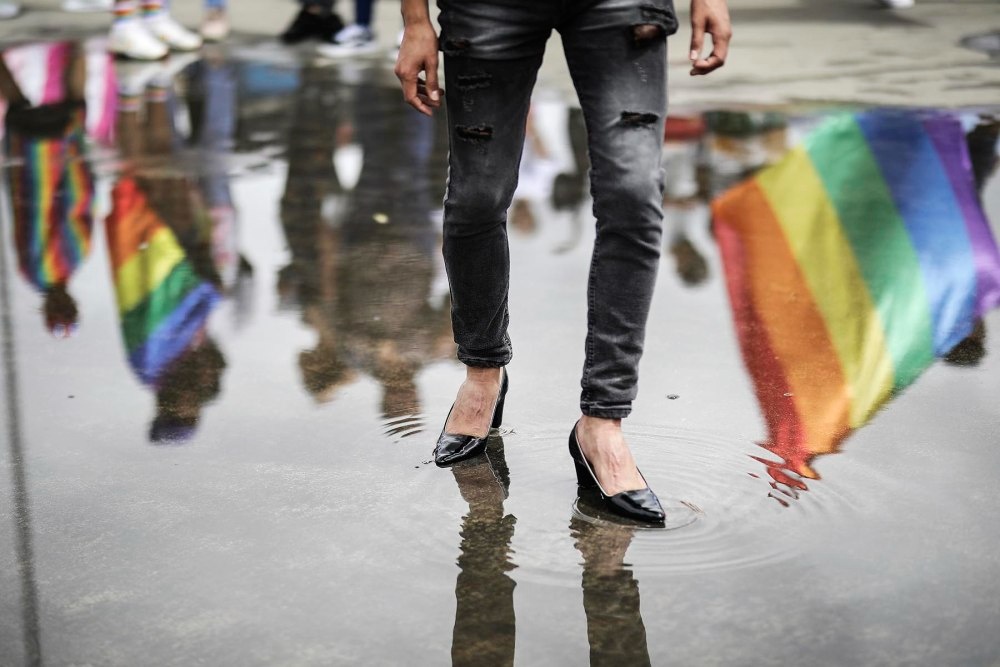
A participant in heels marches in the Gay Pride parade in Bogotáx, Colombia, in 2023.
Juan Viana, 48, recalls having a happy childhood in a Christian community in Bogotá, but everything changed when he came out as gay at 18. “Unfortunately, that community that once offered support became a place that deeply rejected who I truly am,” Viana said.
Following the advice of a psychologist, Viana’s family took him to a “conversion therapy” center — institutions that aim to change a person’s sexual orientation or gender identity. “They told me homosexuality was a disease, caused by a demonic force that would destroy my family,” Viana said. He went to the center voluntarily and stayed for months, thinking he was protecting his loved ones, only to find himself trapped in a nightmare. “They break you in every way: physically, mentally,” he said. During that period, he had suicidal thoughts multiple times and even attempted suicide once. “Those were the darkest moments of my life.”
Such traumatic experiences may soon be illegal in Colombia. Data from the country’s Ombudsman’s Office shows that approximately one in five LGBTQ people in Colombia have undergone conversion therapy. Currently, Colombian lawmakers are considering a bill to ban the practice, while countries like China, South Africa, and the United Kingdom still allow it.
Rights groups note that there are an unknown number of unlicensed rehabilitation clinics in Colombia and other parts of Latin America offering conversion therapy, based on the belief that homosexuality, bisexuality, and transgender identities are treatable mental illnesses. However, the World Health Organization removed homosexuality from its list of mental illnesses as early as 1990.
LGBTQ advocates in Colombia have documented various abusive practices in conversion therapy, including humiliation, exorcism, food deprivation, electroshocks, waterboarding, and the rape of lesbian women. In this conservative Catholic country, activists say religion is often used as a cover for such acts, and the new bill seeks to criminalize conversion therapy.
“We hope more and more Colombians will understand that this is what the right to liberty, the right to intimacy, and the right to identity should look like,” said Carolina Giraldo, a lawmaker from the center-left Green Alliance and a proponent of the bill.
Third Time’s the Charm?
Colombia has previously proposed two bills to ban conversion therapy, but both failed due to opposition from conservative lawmakers, evangelical groups, and Catholic organizations. Opponents argued that the ban could land priests and parents in prison, and some even claimed that LGBTQ groups wanted to “turn children gay or transgender.” Conservative Senator Maria Fernanda Cabal, who voted against last year’s bill, said: “Such a ban infringes upon family autonomy by preventing parents from guiding their children.”
According to ILGA-World, an international LGBTQ rights group, at least 17 countries — from Brazil and Mexico to Spain and Vietnam — are developing nationwide legislation targeting conversion therapy. LGBTQ activists in Colombia hope the third proposal will succeed.
“When we first started talking about these practices, no one believed such things still happened in Colombia,” said Danne Belmont, executive director of GAAT, a trans rights group based in Bogotá. A transgender woman herself, Belmont revealed that she was injected with testosterone as a child and underwent exorcisms, all in an attempt to change her identity.
Since the first bill was introduced in 2022, advocates have adjusted their approach to broaden support. Belmont said the current campaign not only emphasizes that “LGBTQ people have nothing to ‘heal’ from” but also urges parents to “love their children always.” “This bill is for all Colombian families, to create safe spaces where people can freely discuss their sexual orientation and gender identity,” she said.
Contrary to the claims of some Catholic lawmakers and ultra-Catholic groups, Father Carlos Guillermo Arias Jimenez of Colombia’s Bishop’s Conference stated that the latest bill does not contradict religious freedom. “The church has never accepted, nor has it ever taught, actions aimed at changing or reversing a person’s sexual orientation,” he said. However, Colombia’s Evangelical Confederation did not respond to multiple requests for comment.
Currently, the bill passed its first reading in Congress in April with support from lawmakers across multiple parties, but it must pass two more readings before next year’s elections.
Survivors, Not Victims
Belmont noted that trauma often prevents many LGBTQ people from realizing they have undergone conversion therapy until they hear stories from their peers. In May, a national network was established in Colombia, bringing together over 50 people who have experienced conversion therapy. They share their stories on social media and at events, hoping to help others.
David Zuluaga, 27, who grew up in a small town in Antioquia, said: “Conversion therapy is often a gradual, sophisticated process that combines religion, spirituality, and psychology, laying the groundwork for harm.” At 12, he began facing manipulation and social isolation; by 14, he was punched in the stomach to make him “vomit the spirit of homosexuality.” His conversion therapy lasted until he was 17, but it took him much longer to understand what had happened, let alone talk about it.
Now openly gay, Zuluaga said: “Fear needs to switch sides. We used to be ashamed of going through this, but those who did this — who still do this — should be ashamed. They mistreat, harm, and torture people.”
South America Editorial Office: Andrés