
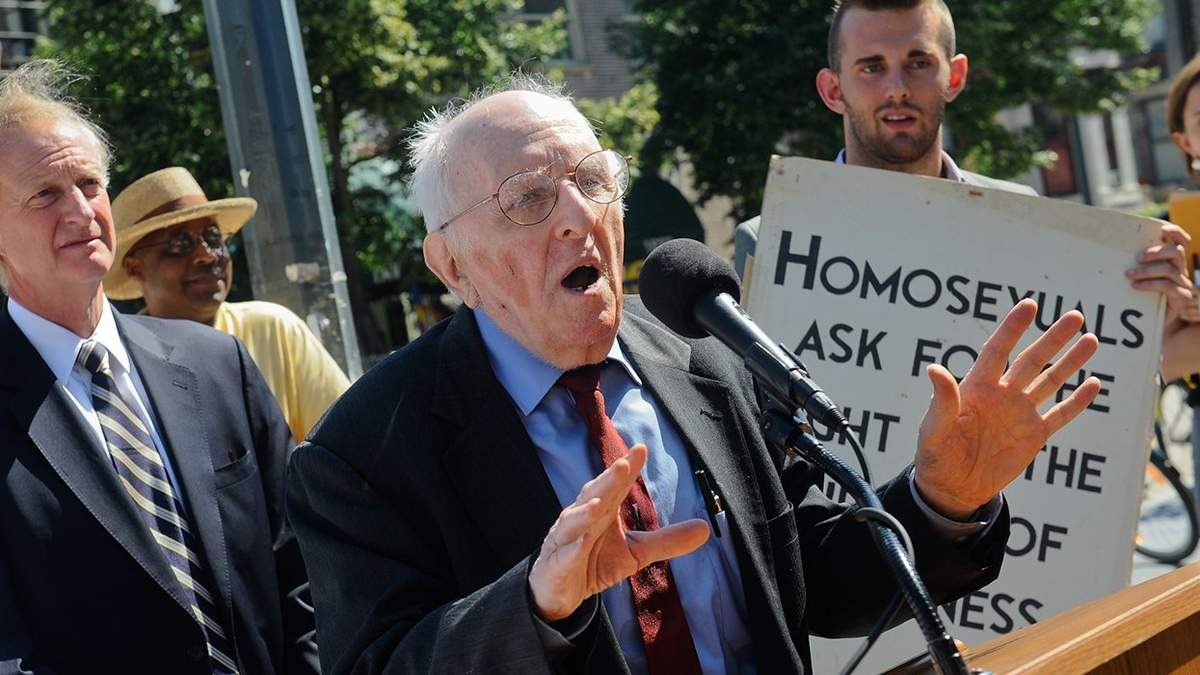
Frank Kameny speaks to the crowd after Washington, D.C., Mayor Adrian Fenty unveiled a new street sign at 17th and R Streets NW dedicated to the gay rights activist in 2010. On the right is an original 1965 protest sign he used in front of the White House.Sarah L. Voisin/The Washington Post via Getty Images
Frank Kameny — born May 21, 1925, and widely regarded as the founding figure of the American LGBTQ civil rights movement — would have turned 100 this year. His journey from federal astronomer to movement architect remains one of the most remarkable trajectories in modern American civic history.
Early Life and Academic Formation
Kameny was raised in a middle-class Jewish household in New York City, where he demonstrated an early aptitude for science. By age 16, he had enrolled at Queens College as a physics major. In 1943, three days before his 18th birthday, he enlisted in the U.S. Army, eventually seeing combat in German-occupied Belgium. After his discharge in 1946, he completed his undergraduate degree and went on to earn a doctorate in astronomy from Harvard University in 1956. The Advocate
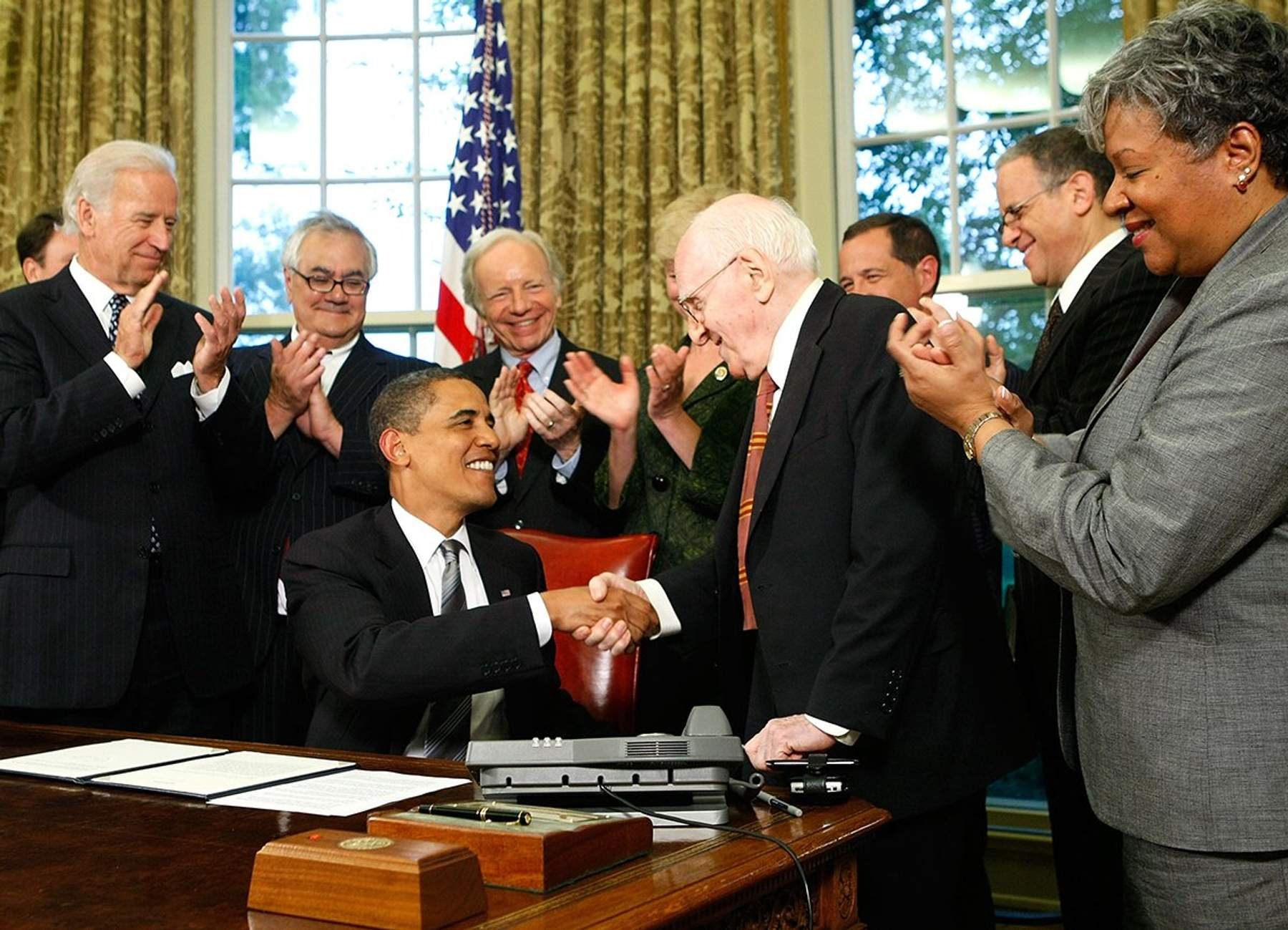
President Barack Obama shakes hands with Frank Kameny (3R) after signing a memorandum extend benefits to same-sex partners of federal employees as (background, from left) Vice President Joe Biden, U.S. Rep. Barney Frank, and U.S.Sen. Joseph Lieberman look on in the Oval Office of the White House, June 17, 2009. Alex Wong/Getty Images
The Dismissal That Defined a Movement
In 1957, Kameny was hired by the Army Map Service to produce astronomical charts for missile guidance systems. The posting suited him well — until federal civil service investigators confronted him with reports of his homosexuality. He refused to answer their questions. Officials subsequently dismissed him, revoked his security clearance, and effectively barred him from the entire federal workforce. The Advocate
The legal basis for his dismissal rested on a 1953 executive order under which the government denied security clearances to gay and lesbian individuals, citing vulnerability to blackmail at a time of intense anticommunist scrutiny. That ban remained in effect until 1995, when it was finally revoked. The Advocate
Rather than accepting his situation in silence, Kameny took the extraordinary step of fighting back through the courts. He lost two federal court battles before petitioning the U.S. Supreme Court — which declined to hear the case. Still, in his petition, he articulated a position of historic significance: that homosexuality was not merely morally neutral but morally affirmative, and that the government had no legitimate authority to discriminate on such grounds. It was, by his own account, the first formal civil rights claim based on sexual orientation ever submitted to an American court. The Advocate
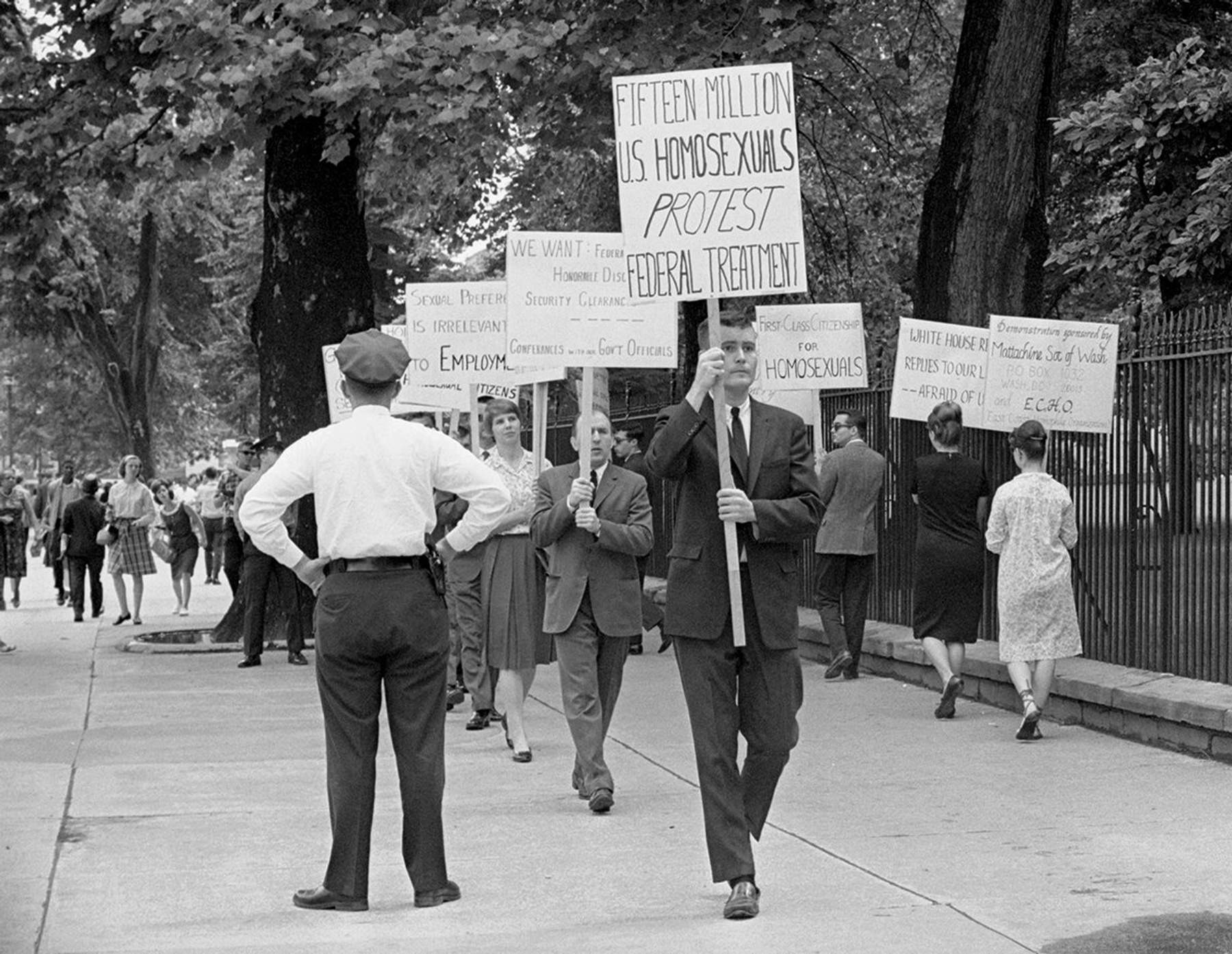
American gay rights activist Jack Nichols (center), followed by Frank Kameny and Lilli Vincenz, protesting with others outside the White House on Armed Forces Day, 1965. The demonstrators were protesting discrimination against gays in the military. Bettmann Contributor/Getty Images
Building the Movement: Organizing and Protest
With legal channels exhausted, Kameny channeled his energies into civic organizing. In 1961, he assumed the presidency of the Washington, D.C., chapter of the Mattachine Society, which he transformed into a publicly assertive advocacy body — one that sent open letters to the president, Congress, and federal agencies demanding equal treatment for gay citizens. The Advocate
In 1965, Kameny led what is recognized as the first gay rights demonstration at the White House, joined by fellow activists including Barbara Gittings and Kay Tobin Lahusen. A second protest occurred on Armed Forces Day that same May. He also organized annual demonstrations at Philadelphia's Independence Hall on July 4, a series that continued through 1969 under the name the Annual Reminder. The Advocate
His approach to public protest was disciplined and deliberate. Participants were required to dress formally — suits and ties for men, dresses for women — a calculated strategy to project the image of respectable, ordinary Americans demanding nothing more than their constitutional rights.
Challenging Medical Classification
One of Kameny's most enduring contributions was his challenge to the psychiatric establishment's classification of homosexuality as a mental disorder. Working alongside Barbara Gittings, Charles Silverstein, Jean O'Leary, and others, Kameny sustained years of advocacy targeting the American Psychiatric Association. In December 1973, the APA's board of trustees voted to remove homosexuality from the Diagnostic and Statistical Manual of Mental Disorders; the full membership ratified the decision the following year. The Advocate The change fundamentally dismantled one of the core institutional justifications for anti-gay discrimination.
The First Openly Gay Congressional Candidate
In 1971, Kameny became the first openly gay candidate for the U.S. House of Representatives, running as an independent for Washington, D.C.'s newly created nonvoting delegate seat. His campaign was notable for its intersectional framing: he called for equal rights not only for gay Americans but for women and Black Americans as well. Though he finished fourth in a field of six, his candidacy compelled mainstream media and rival politicians to publicly engage with gay rights as a legitimate civic issue. The Advocate
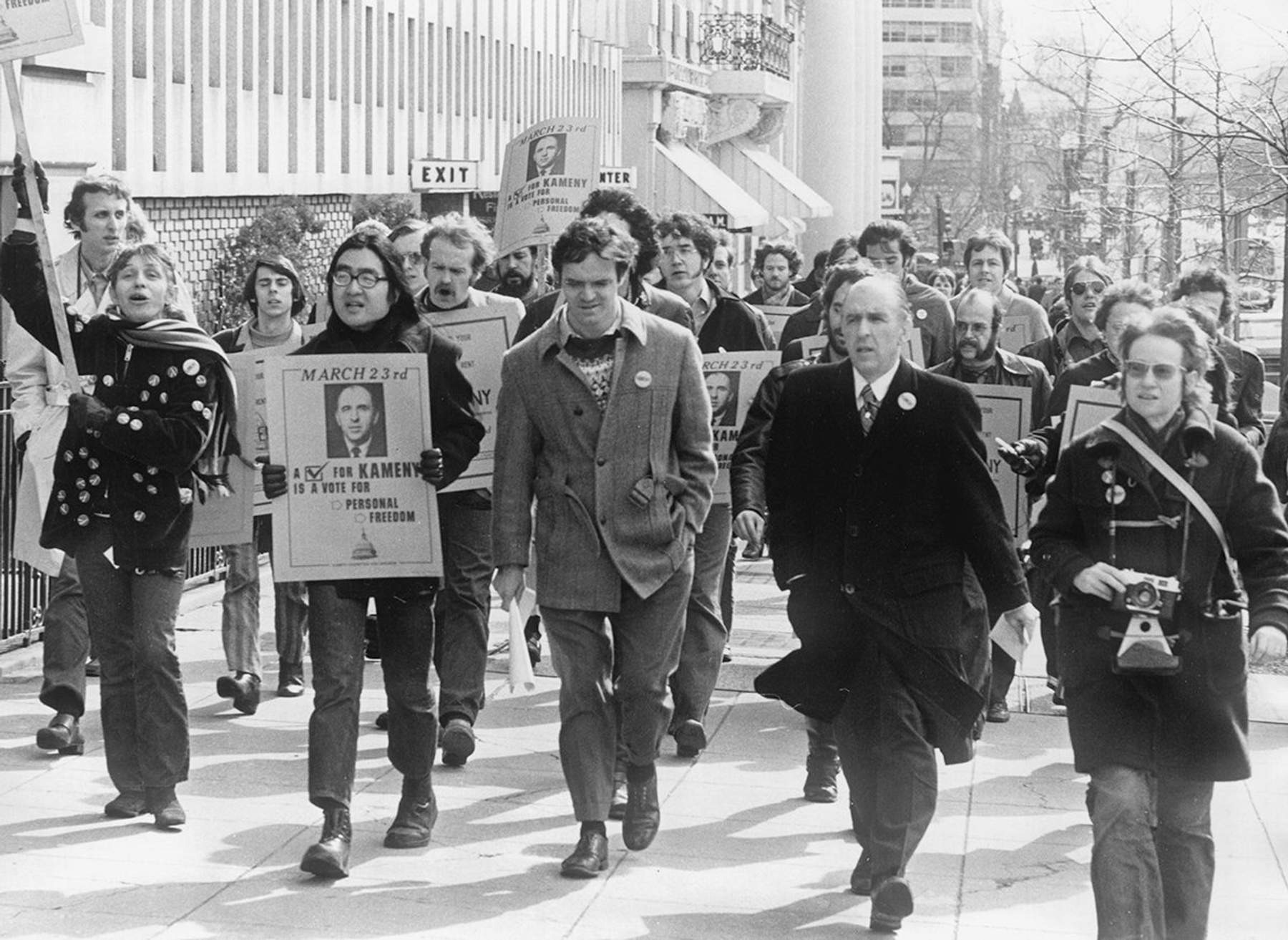
Frank Kameny (second from right) and supporters march to the White House on March 20, 1971, during his campaign for Congress. Kameny held a press conference in which he read a letter he had written to President Richard Nixon. Robert Burchette/The Washington Post via Getty Images
Recognition, Apology, and Posthumous Honors
In 2009, the U.S. government issued a formal apology to Kameny for his 1957 dismissal, delivered by John Berry, then director of the Office of Personnel Management. That same year, Kameny attended a White House ceremony hosted by President Barack Obama. A D.C. street was named in his honor in 2010, and his home was added to the National Register of Historic Places in 2011. In 2015, he was posthumously inducted into the U.S. Department of Labor's Hall of Honor. The Advocate
Kameny died on October 11, 2011 — the same date as National Coming Out Day — at the age of 86, in his Washington, D.C., home.
A Centennial and an Enduring Legacy
From the 39 participants who gathered at the first Annual Reminder demonstration in 1965, the movement Kameny helped build grew to reshape American law and medicine — securing employment protections for gay federal workers, removing homosexuality from the psychiatric disease register, and laying the groundwork for decades of subsequent LGBTQ legal advances. Washington Blade
His slogan — "Gay is Good," coined in 1968 after Kameny drew inspiration from the Black civil rights movement — endures as a foundational affirmation of LGBTQ identity and dignity. Kameny's decades of activism changed the lives of countless lesbian, gay, bisexual, transgender and queer Americans NBC News, and his refusal to accept institutional injustice without resistance remains one of the defining examples of principled civic courage in American history.
North American Editorial Office: Robin